
Use the correction, not the warning
Read the better form aloud, change one word, and repeat it. The corrected phrase is more useful than a long list of prohibitions.
- notice the contrast
- repeat the correct model
- test it in context
These are practical form, spelling, and word-order problems that often make an otherwise understandable sentence sound wrong. Fix one pattern, then reuse it.
Choose iPhone, Android, or Telegram. The Telegram button opens the exact language or exercise.
Your first-session result: Choose one useful activity and finish a focused five-minute practice session.
Updated 3 September 2026 · Product details verified by the KeelAI team.
A free starting point
Check six skills, receive an A1-B2 learning result, and see which exercise to start with.
Keep the practice moving: after reading, check new words, listen to natural speech, or speak with an AI tutor.
Free Lithuanian assessment
For learners who want to check their current Lithuanian level free and receive a concrete practice recommendation.
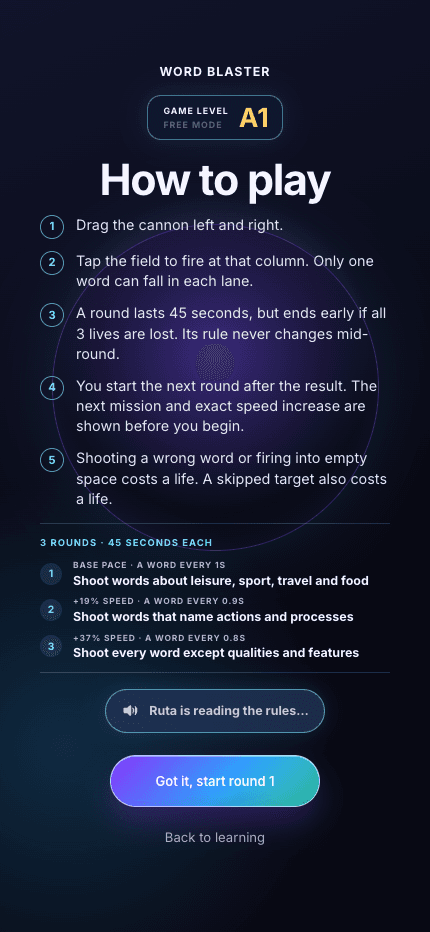
OpenLithuanian word game
For learners who want a quick way to reinforce Lithuanian words between reading, listening, and conversation practice.
OpenLithuanian reader
For learners who want to read Lithuanian texts and understand words without leaving the reading flow.
OpenLithuanian dictionary
For learners who need more than translation: forms, examples, related words, and practical Lithuanian vocabulary.
OpenSee KeelAI in action
Choose the format that fits your next session: read, check a word, listen to a dialogue, or speak with a tutor.

Reader
Texts by level, word help, audio, and progress.

Dialogues
Listen, answer, and check how much you understood.

Live calls
Speak with an AI tutor by voice or text.

KeelAI on YouTube
Ar reikia čekio? means “Do you need a receipt?” Answer Taip, prašau. (“Yes, please.”) if you want one, or Ne, ačiū. (“No, thank you.”) if you do not.
Watch and try itYouTube opens in a new tab.
No long course before your first practice: choose a short task and start using the language.
Read the better form aloud, change one word, and repeat it. The corrected phrase is more useful than a long list of prohibitions.
The Lithuanian reader, dictionary, and Dialogues show how endings, spelling, and word order behave inside complete phrases.
For a complete treatment, use Institute of the Lithuanian Language. This page selects only beginner-facing contrasts for practical study.
Quick reference
Compare the pattern and example, then reuse the same model in a short practice session.
| Problem | Better form | Fix |
|---|---|---|
| Dropping ą, č, ę, ė, į, š, ų, ū, ž | Use a Lithuanian keyboard for full spelling. | Diacritics are part of normal spelling, not decoration. |
| Guessing noun gender from translation | Learn rytas as masculine and diena as feminine. | Save nouns with an adjective or ending pattern. |
| Keeping one ending in every case | Vilnius, Vilniaus, Vilniuje | Practice forms inside phrases instead of isolated charts. |
Compare the problem with the corrected form.
Repeat it once slowly and once at natural speed.
Open a Dialogue and produce one new sentence with the same pattern.
Learners often transfer spelling, word order, or grammar from a language they already know. Short contrasts make the new pattern easier to notice.
No. Speak with short reliable patterns, notice one correction, and continue. Accuracy grows through repeated use.
Use Lithuanian Dialogues, the reader, or a live call in KeelAI to meet the same forms in context.
If this path is close but you need another language or practice format, choose a related route.
Ten languages, AI tutors, voice, reading, listening, and games in one product.
Free to get started · No credit card