
Free Lithuanian assessment
lithuanian level test
For learners who want to check their current Lithuanian level free and receive a concrete practice recommendation.
Start practiceDetailsA beginner does not need every rule at once. KeelAI helps you start Lithuanian with small daily sessions: first phrases, basic vocabulary, short dialogues, and review.
Choose iPhone, Android, or Telegram. The Telegram button opens the exact language or exercise.
Your first-session result: Choose one useful activity and finish a focused five-minute practice session.
Updated 3 September 2026 · Product details verified by the KeelAI team.
Mano vardas Jonas. Aš gyvenu Vilniuje.
Where does Jonas live?
One sentence cannot determine your level. The free test checks several skills and helps you choose your next practice.
A free starting point
Check six skills, receive an A1-B2 learning result, and see which exercise to start with.
Keep the practice moving: after reading, check new words, listen to natural speech, or speak with an AI tutor.
Free Lithuanian assessment
For learners who want to check their current Lithuanian level free and receive a concrete practice recommendation.
Start practiceDetailsLithuanian word game
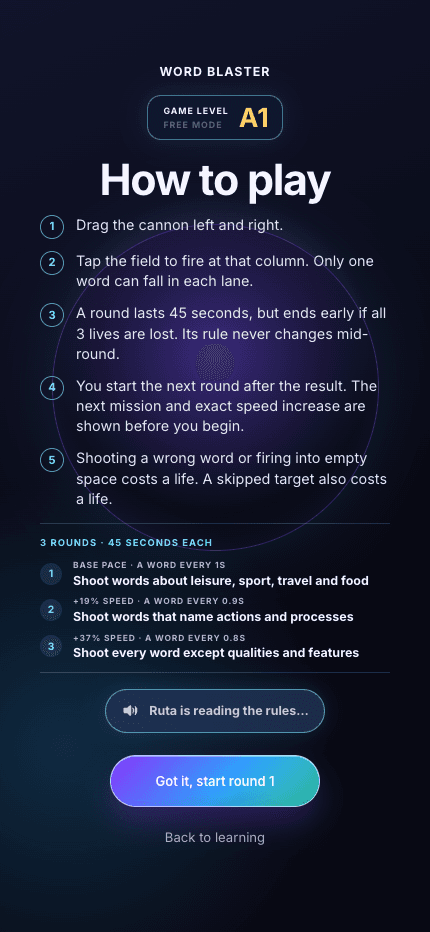
For learners who want a quick way to reinforce Lithuanian words between reading, listening, and conversation practice.
Start practiceDetailsLithuanian reader
For learners who want to read Lithuanian texts and understand words without leaving the reading flow.
Start practiceDetailsLithuanian dictionary
For learners who need more than translation: forms, examples, related words, and practical Lithuanian vocabulary.
Start practiceDetailsSee KeelAI in action
Choose the format that fits your next session: read, check a word, listen to a dialogue, or speak with a tutor.

Reader
Texts by level, word help, audio, and progress.

Dialogues
Listen, answer, and check how much you understood.

Live calls
Speak with an AI tutor by voice or text.

KeelAI on YouTube
Ar reikia čekio? means “Do you need a receipt?” Answer Taip, prašau. (“Yes, please.”) if you want one, or Ne, ačiū. (“No, thank you.”) if you do not.
Watch and try itYouTube opens in a new tab.
No long course before your first practice: choose a short task and start using the language.
The first goal is to make Lithuanian usable in small moments: greeting someone, asking a simple question, recognizing a word, or answering politely.
A useful beginner base is usually 200-500 words tied to your life, not random dictionary lists.
Ask KeelAI to stay at A1, explain every new word, or turn a hard sentence into three simpler versions.
Practice around situations that actually show up in life: conversations, travel, work, family, and everyday services.
Start with greetings, polite phrases, numbers, food, transport, and the first 200-500 words that make Lithuanian usable.
Use short role-plays before real conversations in Lithuania: a shop, an appointment, a meeting, or a travel situation.
Save useful words from practice and review them through flashcards, tests, and levels in KeelAI.
Download KeelAI on iPhone or Android, or open it in Telegram. Choose Lithuanian and continue with the same set of learning tools.
Use prompts such as “practice a cafe order” or “help me introduce myself at work” and keep the level simple or challenging.
Turn useful corrections into vocabulary review, then repeat the same situation until it feels natural.
Yes. Start with short phrases, basic vocabulary, and simple role-play before studying deeper grammar.
Short daily sessions work best: 5-10 minutes of focused practice is enough to build a habit.
If this path is close but you need another language or practice format, choose a related route.
Ten languages, AI tutors, voice, reading, listening, and games in one product.
Free to get started · No credit card