Free Uzbek assessment
uzbek level test
For learners who want to check their current Uzbek level free and receive a concrete practice recommendation.
Start practiceDetails
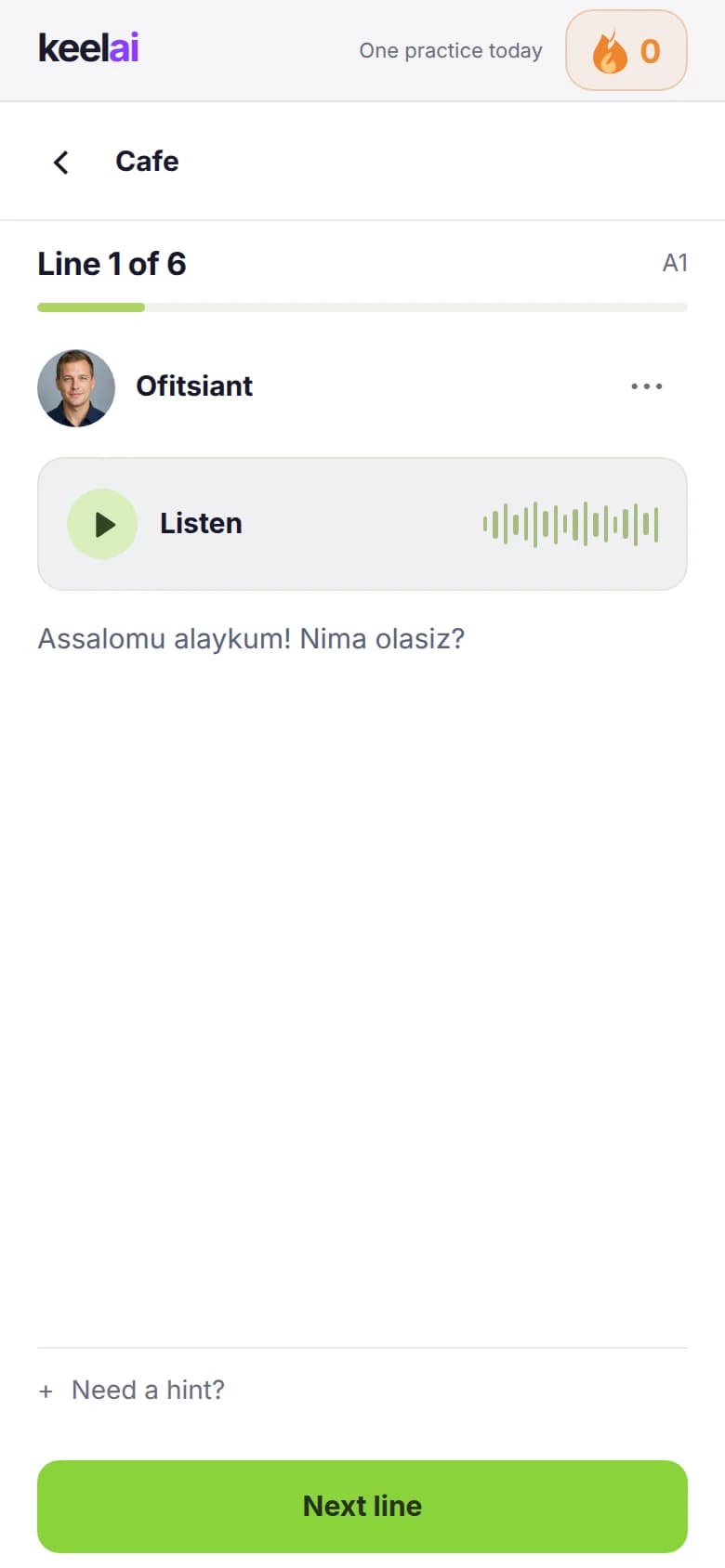
Start with three high-value patterns, see how they work in real phrases, and then test them in a short Uzbek dialogue.
Choose one useful activity and finish a focused five-minute practice session.
Start with three high-value patterns, see how they work in real phrases, and then test them in a short Uzbek dialogue.

Mening ismim Aziza. Men Toshkentda yashayman.
Where does Aziza live?
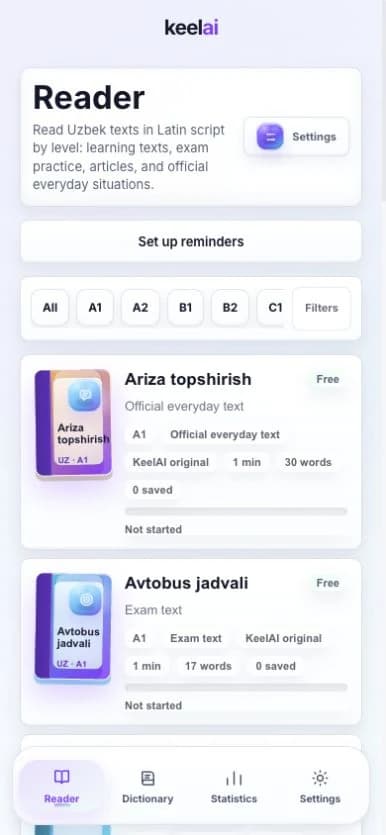
Choose texts by level in the KeelAI reader and tap unfamiliar words to open the built-in dictionary. No Telegram required.
A free starting point
If you have studied the language before, the free test helps you choose where to continue. The result is an estimate, not an official certificate.
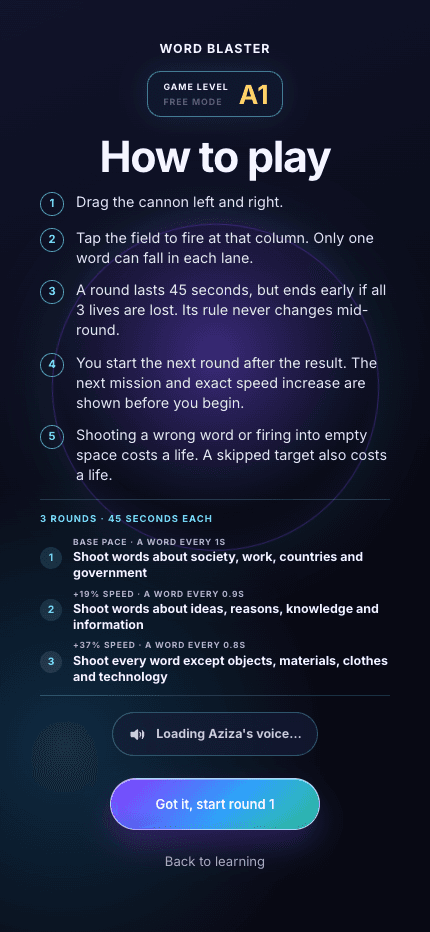
Choose a practice format for your next goal: listening, speaking aloud, or reviewing vocabulary.
Free Uzbek assessment
For learners who want to check their current Uzbek level free and receive a concrete practice recommendation.
Start practiceDetailsUzbek Dialogues
For learners who want short uzbek listening scenes with tasks and feedback.
Start practiceDetailsAziza Live Calls
For learners who want short live-feeling Uzbek speaking practice with an AI tutor in Telegram.
Start practiceDetailsUzbek reader
For learners who want to read Uzbek texts and understand words without leaving the reading flow.
Start practiceDetailsSee KeelAI in action
Uzbek grammar becomes manageable when you learn one sentence pattern at a time and reuse it with new words. The table below covers the first patterns worth noticing.
Save a complete phrase, replace one element, and say or type the new version. This connects grammar to an action instead of an isolated definition.
The reference section links to Ministry of Preschool and School Education of Uzbekistan. KeelAI turns the same core patterns into short practice rather than replacing an official grammar reference.
Quick reference
Compare the pattern and example, then reuse the same model in a short practice session.
| Pattern | Example | Remember |
|---|---|---|
| Subject-object-verb order | Men o‘zbek tilini o‘rganaman. | The finite verb normally closes a neutral sentence. |
| Cases use suffixes | uy, uyga, uyda, uydan | Learn direction, location and source as one pattern. |
| No grammatical gender | u = he or she | Pronouns and adjectives do not change for masculine or feminine gender. |
Focus on one pattern and its example.
Replace one noun, pronoun, place, or action.
Open Uzbek Dialogues and look for the same structure in context.
It has unfamiliar patterns, but beginners do not need the whole system at once. Start with reusable sentence models and add one contrast at a time.
No. Use tables to notice a pattern, then practice the form in a complete sentence.
Yes. Open Uzbek Dialogues for listening, or use the connected reader and dictionary to see forms in context.
If this path is close but you need another language or practice format, choose a related route.
Ten languages, AI tutors, voice, reading, listening, and games in one product.
Free to get started · No credit card