Free Uzbek assessment
uzbek level test
For learners who want to check their current Uzbek level free and receive a concrete practice recommendation.
Start practiceDetails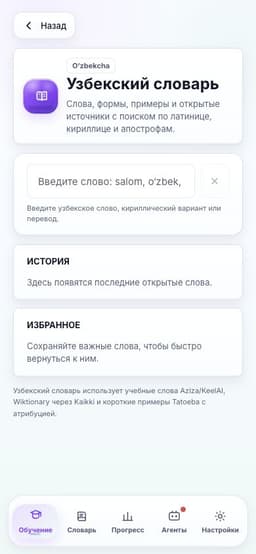
Uzbek becomes clearer when forms, examples, and pronunciation are shown next to meanings instead of separated from real text.
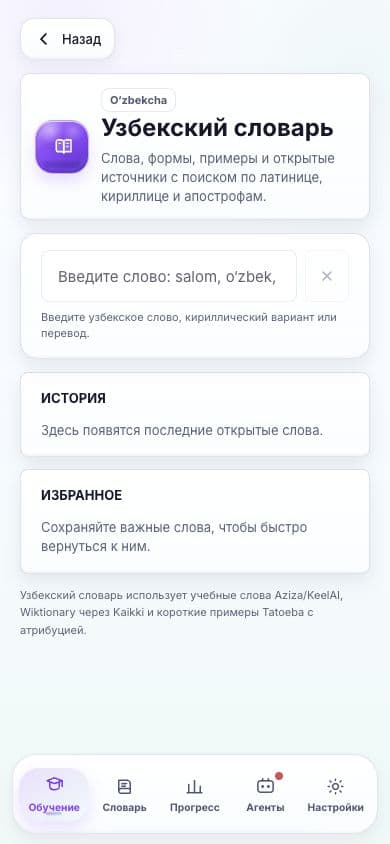
Look up one word, compare its forms, and save a useful example.
Uzbek becomes clearer when forms, examples, and pronunciation are shown next to meanings instead of separated from real text.
Choose a practice format for your next goal: listening, speaking aloud, or reviewing vocabulary.
Free Uzbek assessment
For learners who want to check their current Uzbek level free and receive a concrete practice recommendation.
Start practiceDetailsUzbek Dialogues
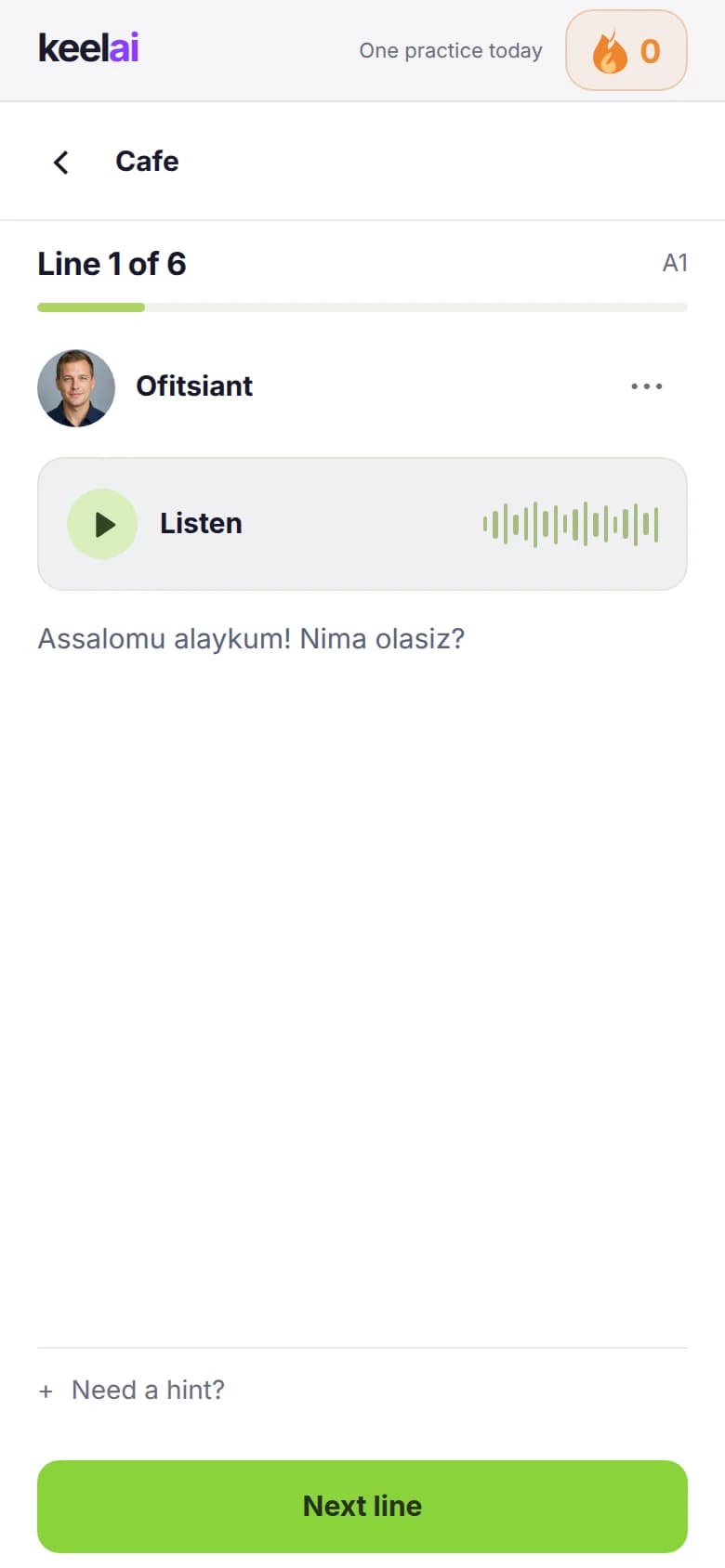
For learners who want short uzbek listening scenes with tasks and feedback.
Start practiceDetailsAziza Live Calls
For learners who want short live-feeling Uzbek speaking practice with an AI tutor in Telegram.
Start practiceDetailsUzbek reader
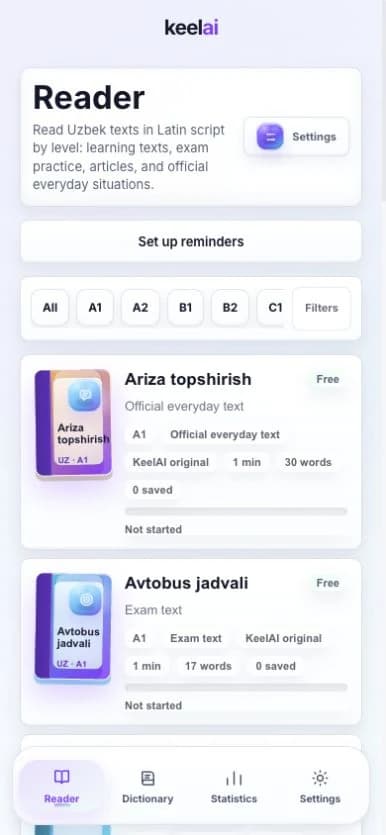
For learners who want to read Uzbek texts and understand words without leaving the reading flow.
Start practiceDetailsSee KeelAI in action
Learn Uzbek word forms by seeing the base word, useful forms, examples, pronunciation, and reader context together instead of memorizing isolated tables.
A dictionary entry should help you recognize a form in a sentence and then use it yourself.
Latin and Cyrillic spellings, suffix chains, possessive forms, and cases can change what a sentence means, so forms matter from the first texts.
Because learners need to recognize forms in context, not only memorize one translation.
Use the KeelAI Uzbek dictionary and reader together: look up a word, inspect useful forms and examples, then meet the same forms again in level-based texts.
If this path is close but you need another language or practice format, choose a related route.
From Estonian to Maltese: conversation, reading, listening and vocabulary. KeelAI supports 10 languages.
Free to get started · No credit card