Free Estonian assessment
estonian level test
For learners who want to check their current Estonian level free and receive a concrete practice recommendation.
Start practiceDetails
Start with one pattern and compare two sentences.
Choose one useful activity and finish a focused five-minute practice session.
Start with one pattern and compare two sentences. Below are three common cases: saying what you have, making a statement negative and changing a noun after “two”. This is a starting point, not a table of every rule.

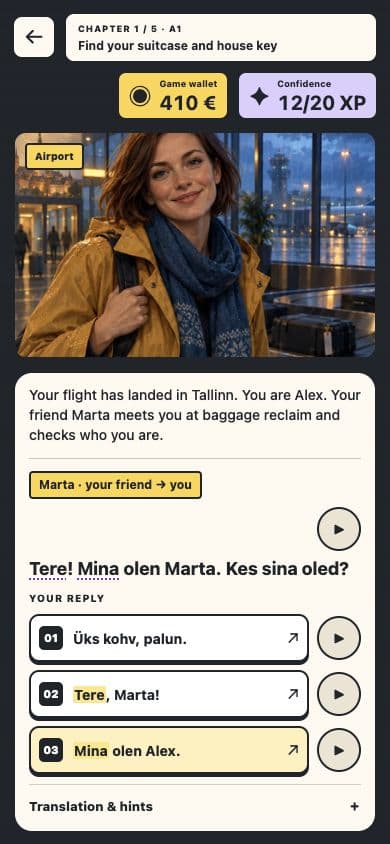
Minu nimi on Mari. Ma elan Tartus.
Where does Mari live?
Choose texts by level in the KeelAI reader and tap unfamiliar words to open the built-in dictionary. No Telegram required.
A free starting point
If you have studied the language before, the free test helps you choose where to continue. The result is an estimate, not an official certificate.
Choose a practice format for your next goal: listening, speaking aloud, or reviewing vocabulary.
Free Estonian assessment
For learners who want to check their current Estonian level free and receive a concrete practice recommendation.
Start practiceDetailsEstonian dialogues
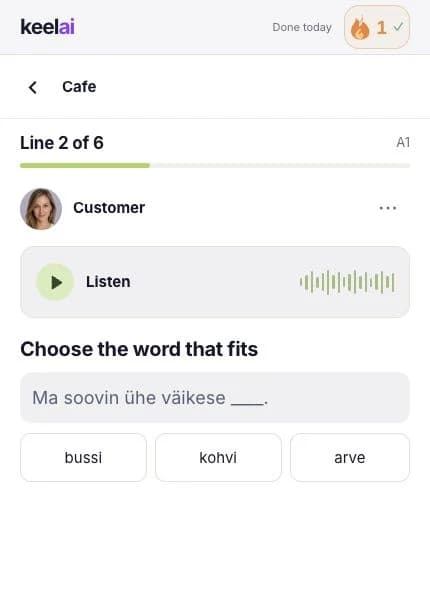
For learners who want to understand spoken Estonian through short level-based dialogues and listening tasks.
Start practiceDetailsMarko Video Calls
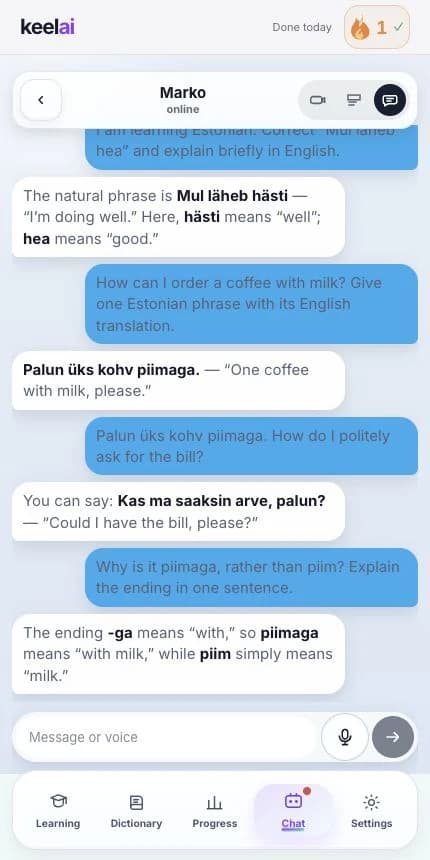
For learners who want live-feeling Estonian speaking practice with an AI tutor inside Telegram.
Start practiceDetailsEstonian reader
For learners who want to read Estonian texts and understand words without leaving the reading flow.
Start practiceDetailsSee KeelAI in action
Make “Ma räägin eesti keelt” negative. Answer: “Ma ei räägi eesti keelt” — “I do not speak Estonian”. Compare the verb endings; do not simply add ei before the original personal form räägin.
Choose “kaks raamat” or “kaks raamatut”. Answer: “kaks raamatut” — “two books”. Here the cardinal number kaks takes the singular partitive. Compare “kolm raamatut” — “three books”. Other constructions need separate explanation.
Quick reference
Compare the pattern and example, then reuse the same model in a short practice session.
| Task | Example | What to notice |
|---|---|---|
| Having and not having | Mul on aega. / Mul ei ole aega. | I have time. / I do not have time. |
| Negating an action | Ma räägin. / Ma ei räägi. | In this example: räägin → ei räägi |
| One and two objects | üks raamat / kaks raamatut | One book / two books; kaks takes raamatut here |
Use a small table for one task: positive and negative statements, possession or noun forms after numbers. Compare complete examples, answer a short question and write your own sentence. Check full paradigms and dictionary forms in a dictionary; a few examples cannot cover all exceptions.
In “kaks raamatut”, the noun is singular partitive, not plural nominative. Compare “üks raamat”, “kaks raamatut” and “kolm raamatut”. This is the pattern for this counting construction; case choice in other sentences depends on context.
If this path is close but you need another language or practice format, choose a related route.
Ten languages, AI tutors, voice, reading, listening, and games in one product.
Free to get started · No credit card