Free Estonian assessment
estonian level test
For learners who want to check their current Estonian level free and receive a concrete practice recommendation.
Start practiceDetailsKnow the translation but not which form to use?
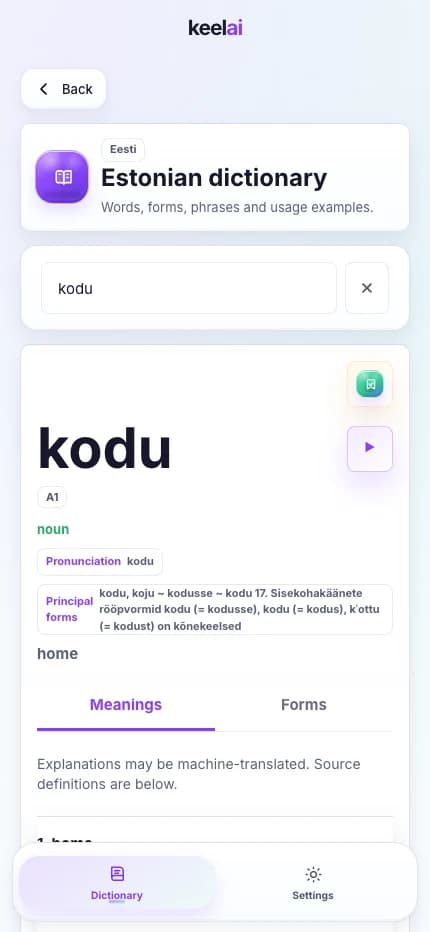
Look up one word, compare its forms, and save a useful example.
Know the translation but not which form to use? Compare raamat, raamatu and raamatut in short phrases. These three forms help you read a dictionary and notice changes, but do not replace the full paradigm or rules for choosing cases.
Start with three basic noun forms: nimetav, omastav and osastav. The last depends on meaning and sentence structure; a translation alone does not determine the case.
| Nimetav | Omastav | Osastav | Example |
|---|---|---|---|
| raamat | raamatu | raamatut | Ma loen raamatut. |
| tuba | toa | tuba | Ma koristan tuba. |
| kool | kooli | kooli | Ma lähen kooli. |
In Ma lähen kooli, kooli is the short illative (where to?), spelled like other forms. Check the form in context. EKI Sõnaveeb.
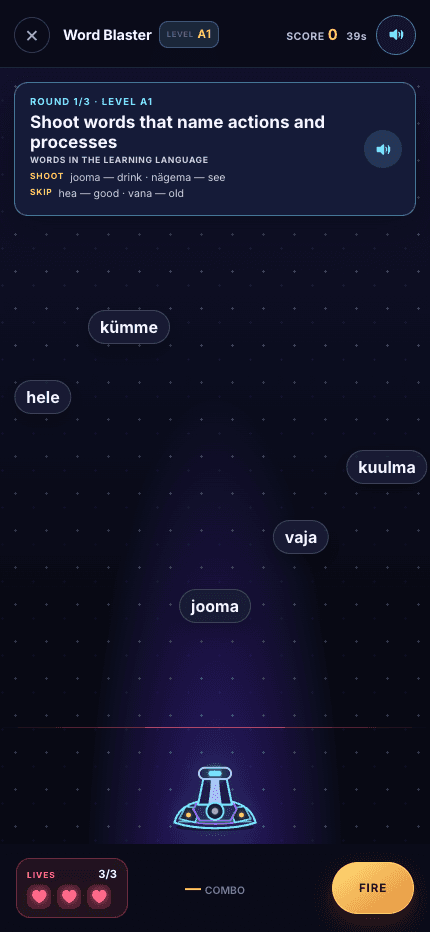
Choose a practice format for your next goal: listening, speaking aloud, or reviewing vocabulary.
Free Estonian assessment
For learners who want to check their current Estonian level free and receive a concrete practice recommendation.
Start practiceDetailsEstonian dialogues
For learners who want to understand spoken Estonian through short level-based dialogues and listening tasks.
Start practiceDetailsMarko Video Calls
For learners who want live-feeling Estonian speaking practice with an AI tutor inside Telegram.
Start practiceDetailsEstonian reader
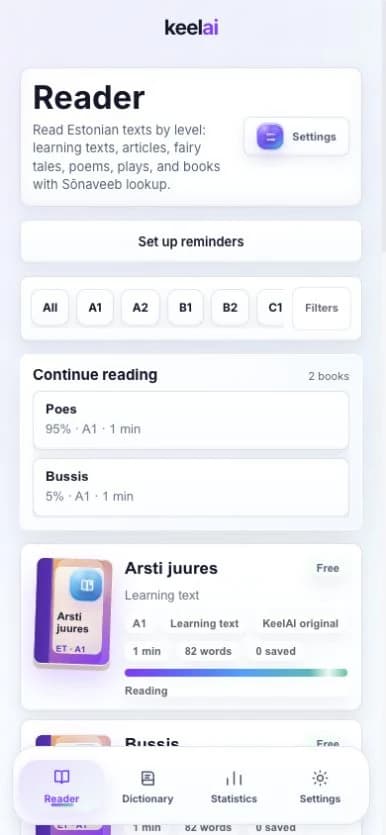
For learners who want to read Estonian texts and understand words without leaving the reading flow.
Start practiceDetailsSee KeelAI in action
The list “raamat, raamatu, raamatut” is easier to understand when each form has a role. In “raamatu hind”, raamatu connects the book with its price. In “kaks raamatut”, the number two takes a singular partitive noun.
Fill the gap: “kaks ___” — “two books”. Options: raamat, raamatu, raamatut. Answer: raamatut. Now hide the table and explain where the other two forms were used. If unsure, check the complete Sõnaveeb entry.
Quick reference
Compare the pattern and example, then reuse the same model in a short practice session.
| Form | Case | In context |
|---|---|---|
| raamat | Nominative (nimetav) | üks raamat — one book |
| raamatu | Genitive (omastav) | raamatu hind — the price of the book |
| raamatut | Partitive (osastav) | kaks raamatut — two books |
For a noun, usually start with singular nominative, genitive and partitive: for example, raamat, raamatu and raamatut. Compare them in context: üks raamat, raamatu hind, kaks raamatut. Use the relevant dictionary entry for the full paradigm and other parts of speech.
No. Three forms help with dictionary work, but case choice depends on the construction and meaning of the sentence. Learn forms in phrases, check examples and practise your own replies. Not every form can be made by adding one ending.
If this path is close but you need another language or practice format, choose a related route.
From Estonian to Maltese: conversation, reading, listening and vocabulary. KeelAI supports 10 languages.
Free to get started · No credit card