
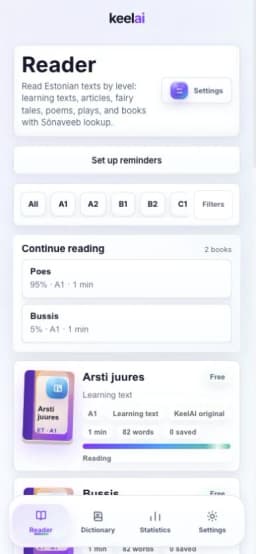
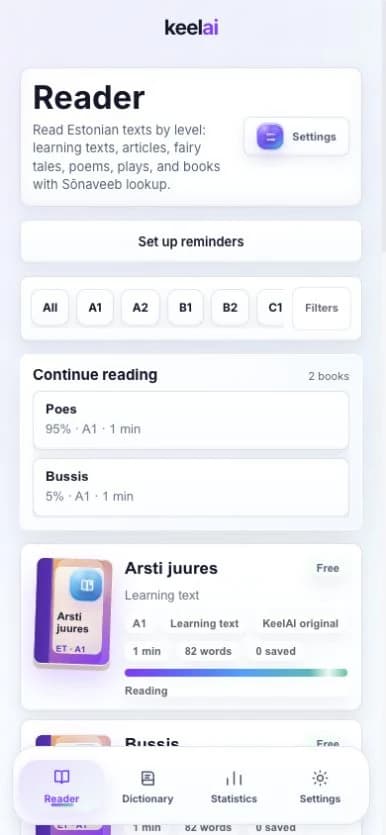
KeelAI

Estonian reading texts by level: A1–B1

Estonian Reader · English interface

Start with a short everyday story or try a text that explains an opinion.

Choose a text and check your understanding

Read without the translation first and answer the question. Then look up unfamiliar words and read again. All examples are available here without registration.

A1 · Everyday situations

A1

My day

Minu nimi on Mari. Ma elan Tallinnas. Hommikul ärkan kell seitse. Ma joon teed ja söön leiba. Kell kaheksa lähen tööle. Minu töökoht on kodu lähedal. Lõunal söön koos sõbraga. Õhtul lähen koju. Ma loen raamatut ja kuulan muusikat. Kell kümme lähen magama. Homme on jälle tööpäev.

Show translation

My name is Mari. I live in Tallinn. I wake up at seven in the morning. I drink tea and eat bread. At eight I go to work. My workplace is close to home. At lunchtime I eat with a friend. In the evening I go home. I read a book and listen to music. At ten I go to bed. Tomorrow is another working day.

hommikul
in the morning
lähedal
near
magama
to sleep
When does Mari wake up?

A1

At the shop

Täna lähen poodi. Pood on minu tänaval. Mul on vaja piima, leiba ja õunu. Ma võtan kaks õuna. Õunad on punased. Leib on värske. Müüja annab mulle piima. Mul on väike kott. Panen toidu kotti ja maksan kaardiga. Ütlen müüjale aitäh. Siis lähen koju ja teen süüa.

Show translation

Today I go to the shop. The shop is on my street. I need milk, bread and apples. I take two apples. The apples are red. The bread is fresh. The shop assistant gives me milk. I have a small bag. I put the food in the bag and pay by card. I thank the shop assistant. Then I go home and cook.

mul on vaja
I need
värske
fresh
kaardiga
by card
How does the person pay?

A2 · Events and plans

A2

A trip to Tartu

Eelmisel laupäeval sõitsin Tartusse. Ostsin bussipileti internetist ja võtsin kaasa väikese koti. Buss väljus hommikul kell üheksa. Teel lugesin raamatut ja vaatasin aknast välja. Tartus kohtusin sõbraga. Kõigepealt jalutasime kesklinnas, siis sõime kohvikus lõunat. Pärast lõunat hakkas vihma sadama, seega läksime muuseumi. Õhtul sõitsin koju tagasi. Järgmisel korral tahan kauemaks jääda.

Show translation

Last Saturday I travelled to Tartu. I bought a bus ticket online and took a small bag. The bus left at nine in the morning. On the way I read a book and looked out of the window. In Tartu I met a friend. First we walked in the centre, then we had lunch in a café. After lunch it started raining, so we went to a museum. In the evening I travelled home. Next time I want to stay longer.

eelmisel
last
kaasa
along
seega
therefore
Why did the friends go to a museum?

A2

A new home

Kolimise järel elan väikeses korteris. Korter on valgusküllane ja sellel on suur köök. Minu aknast paistab park. Bussipeatus on maja kõrval, nii et tööle jõuan kiiresti. Varem sõitsin tööle peaaegu tund aega. Nüüd kulub sõiduks kakskümmend minutit. Naaber näitas mulle lähedal asuvat poodi. Laupäeval tulevad sõbrad külla. Teeme koos süüa ja pärast jalutame pargis.

Show translation

After moving, I live in a small flat. The flat is bright and has a large kitchen. I can see a park from my window. The bus stop is next to the building, so I get to work quickly. My journey to work used to take almost an hour. Now it takes twenty minutes. My neighbour showed me the nearby shop. Friends are coming over on Saturday. We will cook together and then walk in the park.

kolimine
moving home
kõrval
next to
külla
for a visit
Where is the bus stop?

B1 · Opinions and reasons

B1

Working from home

Mulle meeldib kodus töötada, sest ma ei pea iga päev kontorisse sõitma. Hommikul saan rahulikult päeva planeerida ja keskenduda keerulisematele ülesannetele. Samas tunnen vahel puudust kolleegidega suhtlemisest. Seetõttu käin kaks korda nädalas kontoris, kuigi saan enamiku ülesandeid kodus teha. Kontoris arutame ühiseid projekte ja sööme koos lõunat. Kodus pean jälgima, et tööpäev liiga pikaks ei veniks. Õhtul panen arvuti kinni ja lähen jalutama. Minu jaoks toimib kõige paremini mõlema tööviisi ühendamine.

Show translation

I like working from home because I do not have to travel to the office every day. In the morning I can plan my day calmly and concentrate on harder tasks. However, I sometimes miss talking to colleagues. That is why I go to the office twice a week, although I can do most tasks at home. In the office we discuss shared projects and have lunch together. At home I need to make sure the working day does not become too long. In the evening I close my computer and go for a walk. Combining both ways of working suits me best.

samas
however
kuigi
although
keskenduma
to concentrate
Why does the person go to the office?

B1

Choosing transport

Varem sõitsin tööle autoga, kuid nüüd kasutan enamasti ühistransporti. Nii säästan raha ja saan teel lugeda. Bussisõit võtab veidi kauem aega, aga parkimiskohta ei pea otsima. Kui ilm on ilus, lähen hoopis jalgrattaga. Kõige keerulisem on valida siis, kui hommikul sajab, aga õhtuks lubatakse päikest. Eelmisel nädalal jätsin ratta koju ja sõitsin bussiga. Õhtul oli ilm tõesti ilus, kuid ma ei kahetsenud oma valikut. Minu jaoks on oluline jõuda tööle rahulikult ja õigeks ajaks.

Show translation

I used to drive to work, but now I mostly use public transport. This saves money and lets me read on the way. The bus journey takes a little longer, but I do not need to look for parking. If the weather is nice, I cycle instead. Choosing is hardest when it rains in the morning but sunshine is forecast for the evening. Last week I left my bicycle at home and took the bus. The weather really was nice in the evening, but I did not regret my choice. Getting to work calmly and on time matters to me.

ühistransport
public transport
hoopis
instead
õigeks ajaks
on time
Which advantage of the bus is mentioned?

Original learning materials published by KeelAI. A1–B1 labels indicate approximate difficulty: short familiar situations, descriptions of events, then opinions with reasons. These are not officially CEFR-assessed texts or exam tasks. Council of Europe level descriptions.

Not sure which level to choose?

One text only checks reading comprehension. The free test helps estimate several skills and choose your next practice. The result is an estimate, not a certificate.

Check your level free

FAQ

Can I read these texts for free?

Yes. All six texts, translations, vocabulary and questions are available on this page without registration or installation.

Are these official CEFR tasks?

No. These are original KeelAI learning examples. A1–B1 labels describe approximate difficulty, not an official assessment or exam result.

How can I continue reading with a dictionary?

Open the standalone reader for this language using the link after the exercises. In the app you can choose a level and tap unfamiliar words. Available versions and purchase terms are shown in the stores.